

Dryer vent maintenance can be fairly straightforward in a single-family residence where the laundry room sits against an exterior wall. Condos and townhomes can be different. The dryer may be located in an interior closet, on an upper floor, or far from the exterior termination. The vent route may pass through concealed spaces that the individual owner cannot easily inspect.
There is also another question that does not come up as often in detached houses: who is responsible for which part of the system?
A condo owner in the Tampa area once reported that clothes were taking longer to dry even though the lint screen was cleaned after every load. The connection immediately behind the dryer looked clear, so there seemed to be little reason for concern. The exterior termination, however, was not accessible from the unit, and the owner did not know exactly where the vent traveled through the building. Further evaluation found lint accumulation deeper along the exhaust route. The important issue was not poor lint-screen habits. It was a concealed vent configuration that could not be adequately judged from inside the laundry closet.
Situations like this make Dryer Vent Cleaning Tampa, FL for attached properties less about what can be seen behind the appliance and more about understanding the complete route.
When a condo or townhome has an unfamiliar or difficult-to-access exhaust path, professional residential dryer vent cleaning and evaluation can help determine whether buildup is affecting areas beyond the owner’s normal reach.
Condo and Townhome Vent Routes Can Be More Complicated Than They Appear
The distance from the dryer to the nearest exterior wall does not always tell you where the vent goes.
In a townhome, the laundry area may be positioned on an upper floor or between shared walls. In a condominium building, the appliance may sit well inside the unit. Depending on the building design, the exhaust route can travel through concealed areas before reaching an approved exterior termination.
For the owner, most of that path is invisible.
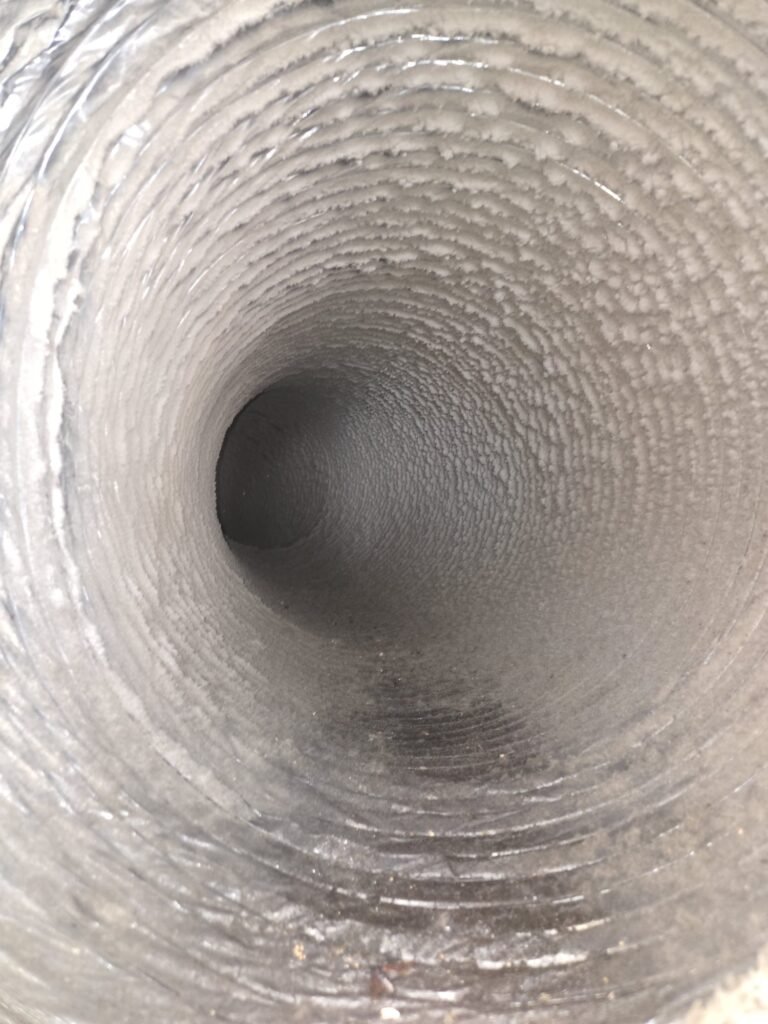
This matters because a longer or more complicated route can have sections that cannot be checked simply by pulling the dryer forward. Turns in the duct and inaccessible areas may also make it harder to determine where lint is accumulating when drying performance changes.
A common mistake is looking into the wall connection, seeing very little lint, and assuming the rest of the route must be equally clear. That opening may represent only a small fraction of the complete exhaust path.
Good Dryer Vent Maintenance Tampa for attached housing begins with understanding the vent configuration as well as possible. Property documents, HOA or condominium association information, previous service records, and professional inspection can all help clarify where the system terminates and who has access to it.
Owners trying to understand an unfamiliar setup can explore local dryer vent services for Tampa residential properties when the concealed route makes routine maintenance difficult to evaluate.
Find Out Whether the Owner or Association Is Responsible for Maintenance
Before arranging work in a condominium, determine who is responsible for the dryer vent.
Responsibility can vary by property. The individual owner may be responsible for the appliance and portions of the vent serving the unit, while an association may control certain exterior or common-area components. Another building may define those responsibilities differently.
Do not assume.
Review the association’s maintenance guidelines or governing documents and ask property management when necessary. This is particularly important if professional access requires entering a common area, reaching an elevated exterior termination, or working on a building component controlled by the association.
A townhome community may have its own rules as well. Even when an owner is responsible for the entire vent serving the residence, exterior access or modifications may still be subject to community requirements.
This can affect Residential Dryer Vent Cleaning Tampa in a practical way. Knowing responsibility before the appointment can prevent a situation where a technician can access the dryer but not the exterior portion needed to properly evaluate the route.
If the property manager confirms that service is the owner’s responsibility, schedule a dryer vent evaluation with the appropriate access information ready so the vent can be assessed as completely as the property allows.
Limited Exterior Access Makes Indoor Warning Signs More Important
A single-family homeowner may be able to walk outside and observe the dryer termination while the appliance runs. A condo owner on an upper floor may not have that option.
When the termination cannot be safely accessed or even easily identified, changes inside the unit become particularly useful.
Pay attention to familiar drying times. If towels that normally finish during one cycle begin needing another, record the change. Notice whether the laundry closet becomes unusually warm during use or whether the dryer seems to be operating differently from its normal pattern.
These observations do not prove there is a clogged vent. Appliance problems, load size, settings, and other conditions can produce similar symptoms. They simply provide reasons to investigate.
For Clogged Dryer Vent Cleaning Tampa, professional assessment becomes more valuable when an owner cannot observe the entire system independently. A technician can consider the accessible vent components and property configuration instead of relying solely on what is visible from the laundry room.
Attached properties can also have other heavily used exhaust systems. If a condo or townhome kitchen has accumulated grease around its hood, professional kitchen range hood cleaning and maintenance addresses that separate system rather than treating all household exhaust equipment as the same maintenance task.
Shared Walls Do Not Always Mean Shared Dryer Vents
One misconception in attached housing is that neighboring units automatically share the same dryer exhaust system. Building layouts vary, and many condos and townhomes have individual vent routes serving each dryer.
That distinction matters when troubleshooting.
If one resident experiences slow drying, it does not necessarily mean neighboring units will have the same problem. The issue may be limited to that unit’s vent route, transition connection, exterior termination, or appliance.
Before arranging Dryer Vent Cleaning, property owners should try to understand which components belong specifically to their unit. Building plans, association records, or previous maintenance information may provide useful details.
This becomes especially important when multiple exterior terminations are grouped together or when the vent exits in an area controlled by the association. Correctly identifying the route helps prevent assumptions about which termination belongs to which dryer.
Owners who are unsure how their individual system is configured can explore professional residential dryer vent evaluation for attached properties to better understand the accessible portions of the exhaust route.
Upper-Floor Laundry Rooms Can Create Different Access Challenges
Townhomes commonly place bedrooms upstairs, and the laundry room may be located on the same level for convenience. Some condominium units also have dryers positioned far above ground level.
That can make exterior access much more complicated.
A termination that would be easy to observe on a ground-floor residence may require specialized access when it is several stories above the ground. Property owners should not attempt to reach elevated vent covers from unsafe positions simply to check for lint.
A Tampa townhome owner encountered this after noticing that towels were taking progressively longer to dry. The connection behind the appliance looked normal, but the owner could not safely inspect the exterior termination because it was positioned high on the building.
When the vent was professionally evaluated, lint accumulation was found farther along the exhaust route. The owner had been keeping the lint screen clean, but that routine maintenance could not address material already inside the concealed duct.
The practical takeaway is straightforward. Limited exterior access makes professional evaluation more useful when performance changes because the resident has fewer safe ways to observe the complete system.
For upper-floor laundry rooms showing persistent drying changes, professional cleaning of the residential dryer exhaust route can address areas that are not safely accessible during routine household maintenance.
Laundry Closets Can Make Vent Connections Easy to Overlook
Space is often limited in condos and townhomes. Washers and dryers may be installed in compact closets where there is little room behind or beside the appliances.
That arrangement can make the transition connection difficult to see.
If a dryer is pushed too far backward, the connection may become compressed or sharply bent. In a spacious laundry room, that condition may be easier to notice. Inside a tight closet, it can remain hidden until drying performance changes.
Appliance replacement deserves particular attention. A new dryer may have slightly different dimensions from the previous model. Even a small difference in depth can affect the space available for the connection.
This is why Dryer Vent Maintenance Tampa for compact laundry areas should include consideration of the accessible connection whenever the appliance is installed, replaced, or moved.
A new dryer connected to an older or poorly positioned exhaust route may still experience performance problems. Replacing the appliance does not automatically correct the vent serving it.
Property owners who notice a tight or questionable installation can request a professional dryer vent assessment for their condo or townhome rather than repeatedly moving the appliance and risking further damage to the connection.
Rental Condos Require Clear Maintenance Responsibilities
Condos are frequently used as rental properties, which adds another person to the maintenance relationship: the tenant.
A tenant may be responsible for cleaning the lint screen during normal use, while the property owner handles professional maintenance. The condominium association may control exterior access. If those responsibilities are never clearly established, dryer vent issues can go unnoticed.
Guest and tenant complaints can provide useful early information.
A renter might report that towels need two cycles, the dryer seems unusually slow, or the laundry closet becomes warmer during operation. Those comments should be documented rather than dismissed as appliance preference.
They do not automatically prove that Clogged Dryer Vent Cleaning Tampa is required. The dryer itself may need service, or a load may have been unusually large. Repeated complaints across different occupants or loads, however, create a stronger reason to investigate.
Property owners can make maintenance easier by telling tenants what they should report and ensuring that lint-screen cleaning is part of normal dryer use.
For landlords managing multiple attached units, Commercial Dryer Vent Cleaning Tampa may be relevant in certain commercial laundry settings, but individual residential condos should not automatically be treated as commercial systems simply because they are rentals. The equipment and actual vent configuration should determine the appropriate service.
Owners managing rental units can review Tampa-area dryer vent maintenance solutions to establish a practical approach based on occupancy, vent access, and the property’s specific responsibilities.
Why Condo Owners Should Pay Attention to Changes in Normal Drying Time
When much of the dryer vent is concealed, the appliance’s everyday performance becomes one of the most useful things an owner can monitor.
You do not need to record the exact number of minutes for every load. Instead, notice whether familiar laundry begins behaving differently. If a normal load of towels once finished during one cycle but now regularly comes out damp, that change provides useful information.
The key is consistency.
One unusually slow load may result from overloading, heavy fabrics, or the wrong dryer setting. Repeated changes across similar loads deserve more attention, particularly when the vent has an unknown service history.
In a condo, it may be impossible for the owner to visually inspect the entire exhaust route. That makes performance changes especially valuable when deciding whether Dryer Vent Cleaning should be considered.
A professional can evaluate the accessible portions of the system and determine whether residential dryer vent cleaning for condos and townhomes is appropriate based on the actual condition rather than drying time alone.
Appliance Replacement Is a Good Time to Check the Vent Connection
Replacing a dryer gives property owners an opportunity that does not come along often. With the old appliance removed, the connection and surrounding laundry space are easier to inspect.
This is particularly useful in compact condo laundry closets.
Look for excessive lint around the wall connection, visible damage, or anything unusual about how the new appliance will connect to the exhaust route. Once the new dryer is installed, make sure it is not positioned so tightly that the transition duct becomes compressed.
A newer dryer can still perform poorly when connected to a restricted or poorly configured vent.
Technicians sometimes arrive after an owner has replaced an appliance specifically because the old dryer was taking too long. When the new machine produces similar results, attention finally turns to the exhaust route. Checking the vent during replacement can help avoid that sequence.
For Residential Dryer Vent Cleaning Tampa, the age of the appliance and the age of the vent should be treated separately. One may be brand new while the other has served the unit for many years.
Before installing a replacement appliance into an unfamiliar exhaust system, owners can review Tampa-area dryer vent inspection and maintenance options to establish whether the route needs attention.
Coordination With the HOA or Property Manager Can Make Service Easier
For detached houses, arranging dryer vent service may involve only the resident and technician. Attached communities sometimes require another layer of coordination.
If the exterior termination is located on a common building surface, behind a locked access area, or somewhere that requires association approval, confirming access before the service appointment can save considerable time.
Ask the property manager whether technicians need advance authorization and whether exterior work has specific community requirements. If the association maintains part of the vent system, determine exactly where the owner’s responsibility ends.
This is also useful when several residents report similar dryer problems. The situation may warrant coordination at the property-management level rather than having each owner make assumptions independently.
For Dryer Vent Maintenance Tampa, good communication can be just as important as physical access. The technician needs to know which components can be reached and whether any restrictions apply to exterior areas.
When professional attention is needed, contact a Tampa dryer vent specialist to discuss the property’s access requirements before the appointment.

Maintenance Decisions Should Reflect the Individual Unit
Two condos in the same building can have different laundry habits.
One unit may house a single resident who runs a few loads each week. Another may have a family doing laundry almost every day. Rental units can experience another pattern entirely as occupants change.
That means maintenance should not be based only on the building address.
Usage, drying performance, vent configuration, previous service, and accessible condition all matter. Even when an association coordinates periodic maintenance, owners should still pay attention to changes inside their own units.
The same applies to Clogged Dryer Vent Cleaning Tampa. Longer drying time alone does not prove that lint is blocking the exhaust. A compressed connection, appliance problem, or another condition can create similar symptoms.
Professional evaluation helps separate those possibilities.
In larger facilities with centralized or genuinely commercial laundry equipment, Commercial Dryer Vent Cleaning Tampa may involve different considerations from an individually vented residential condo. Service should match the actual system rather than the type of ownership.
Owners developing a maintenance plan can explore local dryer vent solutions for Tampa properties based on their unit’s specific setup and usage.
Condo kitchens can also have exhaust systems with limited access. If grease and cooking residue have accumulated around the hood, professional kitchen range hood cleaning for residential properties addresses that equipment separately from the dryer vent.
Build a Dryer Vent Plan That Fits Your Condo or Townhome
Dryer vent maintenance in an attached property works best when the owner understands three things: how the dryer normally performs, where maintenance responsibility lies, and how much of the exhaust route can actually be accessed.
Start with the parts under your control. Keep the lint screen clean, pay attention to changes in familiar drying times, inspect the visible connection when safely possible, and keep records of previous professional service. If the exterior termination is controlled by an HOA or condominium association, confirm their requirements before arranging work.
Persistent changes deserve more attention. If similar loads repeatedly need extra drying time, the vent has an unknown maintenance history, the connection appears compressed, or parts of the exhaust route cannot be safely inspected, professional residential dryer vent cleaning and evaluation can help determine what is happening beyond the visible portions of the system.
Superb Dryer Vent Cleaning serves residential properties throughout the Tampa area. Condo and townhome owners can explore local dryer vent solutions for Tampa properties when developing a maintenance plan that fits their building configuration and laundry use.
Other exhaust equipment should be handled separately. If frequent cooking has left grease and residue around the kitchen hood, consider professional kitchen range hood cleaning for your property rather than assuming dryer vent service addresses both systems.
The supplied local business profile and customer feedback can also help property owners review Superb Dryer Vent Cleaning’s local service experience before choosing professional assistance.
The most important point with Dryer Vent Cleaning Tampa, FL in condos and townhomes is that the system may extend beyond what the individual owner can see or access. A clean lint screen and tidy laundry closet are good maintenance habits, but they do not reveal the condition of a concealed vent route. Knowing your building’s responsibilities and responding to changes in normal dryer performance provides a much stronger maintenance approach.
When repeated warning signs appear, schedule a professional dryer vent evaluation for your condo or townhome.
Frequently Asked Questions
How often should a condo dryer vent be cleaned?
There is no single interval that fits every condo. Laundry volume, vent length, number of turns, previous maintenance, and drying performance all matter. Association requirements may also affect the maintenance schedule in some buildings.
Is the condo owner or HOA responsible for dryer vent cleaning?
It depends on the community’s governing documents and maintenance policies. An owner may be responsible for the vent serving the individual unit, while an association may control certain exterior or common-area components. Confirm responsibility with property management before scheduling work.
Do condo dryers share vents with neighboring units?
Do not assume they do. Many properties have individual exhaust routes for each dryer, while building configurations vary. Property documentation or management can help clarify how your particular system is arranged.
How do I know if my condo dryer vent may be clogged?
Repeatedly longer drying times, unusual lint accumulation, changes in dryer performance, or weak exhaust where the termination can be safely observed may justify an evaluation. These symptoms can have other causes, so they do not confirm a blockage by themselves.
Can I clean a condo dryer vent myself?
Routine tasks such as cleaning the lint screen are appropriate for residents. Concealed routes, elevated exterior terminations, and areas controlled by an association can require different access. Avoid attempting to reach sections that cannot be accessed safely.
Why does my condo dryer take two cycles to dry towels?
A restricted exhaust route is one possibility, but overloading, dryer settings, heavy fabrics, a compressed connection, or an appliance problem can produce similar results. Repeated changes across familiar loads provide a good reason for further evaluation.
Does a townhome need different dryer vent maintenance from a detached house?
It can. Townhomes may have interior or upper-floor laundry areas, longer concealed routes, shared exterior structures, and community access requirements. Maintenance should reflect the actual configuration rather than the property label alone.
When should I consider Dryer Vent Cleaning Tampa, FL for my condo?
Consider professional evaluation when drying performance consistently changes, the maintenance history is unknown, visible connections raise concerns, or substantial portions of the exhaust route cannot be inspected from the unit.
Should the dryer vent be checked when replacing a condo dryer?
Yes, appliance replacement is a useful opportunity to inspect accessible connections and consider the vent’s maintenance history. Installing a new dryer does not clean or update the existing exhaust route.
Is a rental condo considered commercial for dryer vent cleaning?
Not necessarily. A rental condo with ordinary household laundry equipment may still use a residential vent system. Commercial Dryer Vent Cleaning Tampa is more relevant when the property uses commercial equipment or has a commercial laundry configuration. The actual system should determine the service approach.